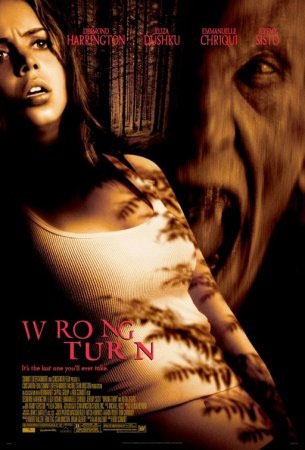
::Wrong Turn 1::2003


An efficient, unpleasant and tiresome hick horror flick, "Wrong Turn" is stocked with victims you won't care about, chased by villains you won't believe.

The photogenic fodder is four friends and a stranger (Desmond Harrington), who end up stranded in the country after a car crash. Vehicle-free, the group set out for help, but as they are in the woods, and this is in America, BAD THINGS are bound to happen.

Scott (Jeremy Sisto) knows this, and when they stumble upon a dilapidated, creepy old house, says to his companions, "I need to remind you of a little movie named "Deliverance"."

Except, of course, he doesn't: John Boorman's thriller is a familiar territory, as is "The Texas Chainsaw Massacre", which this is inevitably derivative of, without being anywhere near as unrelenting or as scary (or scary, full stop).

Sisto is an engaging presence, but as he's the designated 'Funny Guy', you know it's only a matter of time before he's butchered, leaving the blander cast members to make a break for it.

Their pursuers, you've no doubt guessed by now, are variations on the theme of 'Grotesque Redneck Freak' - three inbred, deformed grunters, identified in the credits as Saw-Tooth, One-Eye, and Three Finger.

They're not very bright, but then neither is their prey, who on one occasion reject the chance to kill the killers in their sleep - opting instead to sneak out and be slaughtered themselves.

There are some decent jumps as the hunt tears on, but mainly of the cheap, BOOM! LOUD MUSIC type, while the dialogue is of the state-the-bleedin'-obvious variety ("They're trying to smoke us out!").

As the would-be gutsy totty, Eliza Dushku is surprisingly bad, while Harrington is reminiscent of Paul Walker ("2 Fast 2 Furious"), which tells its own story.

As sub-"Friday the 13th"-style slashers go, there are plenty worse, but this is really only for desperate genre fans - who've already been there, seen it, and bought the bloody t-shirt.

End Credits

Director: Rob Schmidt

Writer: Alan B McElroy

Stars: Eliza Dushku, Desmond Harrington, Jeremy Sisto, Emmanuelle Chriqui, Lindy Booth

Genre: Horror, Thriller

Length: 84 minutes

Cinema: 27 June 2003

Country: USA

::Gangs of Newyork::


GANGS OF NEW YORK,'' Martin Scorsese's brutal, flawed and indelible epic of 19th-century urban criminality, begins in a mud-walled, torchlighted cavern, where a group of warriors prepare for battle, arming themselves with clubs and blades and armoring themselves in motley leather and cloth. Though this is Lower Manhattan in 1846, it might as well be the Middle Ages or the time of Gilgamesh: these warlike rituals have an archaic, archetypal feeling.

And the participants are aware of this. As the members of various colorfully named Irish gangs emerge into the winter daylight of Paradise Square (a place long since given over to high-rises and resurrected here on the grounds of the vast Cinecittà studio complex in Rome), their native-born Protestant enemies greet them with an invocation of ''the ancient laws of combat.'' The ensuing melee turns the new-fallen snow pink with blood and claims the life of Priest Vallon (Liam Neeson), an Irish gang chieftain whose young son witnesses the carnage.

Sixteen years later, the boy, whose name is Amsterdam, has grown into Leonardo DiCaprio, his wide, implacable face framed by lank hair and a wispy Van Dyke. He returns from a long stint in the Hell Gate Reformatory to his old neighborhood, the Five Points, and finds it ruled by his father's killer, Bill Cutting (Daniel Day-Lewis), known as the Butcher, a swaggering monster who has turned the anniversary of Priest's death into a local holiday.

Like a figure out of Jacobean theater or a Dumas novel, Amsterdam is consumed by the need for revenge. With the help of a boyhood friend (Henry Thomas), he infiltrates the Butcher's inner circle, becoming a surrogate son to the man who assassinated his father and who now, in accordance with those ancient laws, venerates Priest's memory.

The New York evoked in Amsterdam's voice-over is ''a city full of tribes and war chiefs,'' whose streets are far meaner than any Mr. Scorsese has contemplated before. The Butcher has formed an alliance of convenience with Boss Tweed (Jim Broadbent), the kingpin of Tammany Hall, and together they administer an empire of graft, extortion and larceny that would put any 20th-century movie gangster or political boss to shame. Rival fire companies turn burning buildings into sites of rioting and plunder; crowds gather to witness hangings, bare-knuckled boxing contests and displays of knife throwing.

As new immigrants, from Ireland and elsewhere, pour off the ships in New York harbor, they are mustered into Tweed's Democratic Party and then, since they lack the $300 necessary to buy their way out, into the Union Army. Occasionally a detachment of reform-minded swells will tour the Points, availing themselves of the perennial privileges of squeamish titillation and easy moral superiority. This anarchic inferno is, in Amsterdam's words, not so much a city as ''a cauldron in which a great city might be forged.''

And in recreating it, Mr. Scorsese has made a near-great movie. His interest in violence, both random and organized, is matched by his love of street-level spectacle. His Old New York is a gaudy multiethnic carnival of misrule, music and impromptu theater, a Breughel painting come to life. Though the details of this lawless, teeming, vibrant milieu may be unfamiliar, we nonetheless instinctively recognize it, from the 19th-century novels of Dickens and Zola, from samurai movies and American westerns and from some of this director's previous films.

Most notably in ''Mean Streets, ''Goodfellas,'' ''The Age of Innocence'' and ''Casino,'' Mr. Scorsese has functioned as a kind of romantic visual anthropologist, fascinated by tribal lore and language, by half-acknowledged codes of honor and retribution and by the boundaries between loyalty and vengeance, between courtesy and violence, that underlie a given social order.

As in ''Casino'' and ''The Age of Innocence,'' the setting of ''Gangs'' is sometimes more interesting than the story. At 2 hours 45 minutes, the film, deftly edited by Mr. Scorsese's frequent collaborator Thelma Schoonmaker, moves swiftly and elegantly. It is never dull, but I must confess that I wish it were longer, so that the lives of the protagonists, rather than standing out in relief against a historical background, were more fully embedded within it. The quasi-Oedipal struggle between Amsterdam and Bill is meant to have a mythic resonance, but that makes it the most conventional element in the picture.

The relationship between the two men is triangulated by Jenny Everdeane (Cameron Diaz), a flame-haired thief (and a protégée of Bill's) who catches Amsterdam's eye and steals his lucky religious medallion. But like Sharon Stone in ''Casino,'' Ms. Diaz ends up with no outlet for her spitfire energies, since her character is more a structural necessity -- the linchpin of male jealousy -- than a fully imagined person. The limitations of her role point to a more serious lapse, which is the movie's lack of curiosity about what women's lives might have been like in Old New York.

Like Tony Soprano's crew in the V.I.P. room at the Bada Bing, Bill and his minions spend a lot of time cavorting with half-naked prostitutes, which is fair (and for all I know accurate) enough. But all the glum evocation of lost fathers makes you wonder if any of these guys had mothers, and you wonder what a typical household in the Five Points might have looked like. (Though I, like just about everyone else, had been waiting impatiently for ''Gangs,'' I almost wish Mr. Scorsese and his screenwriters had been delayed long enough to take account of ''Paradise Alley,'' Kevin Baker's new novel about the draft riots of 1863, in which some of the events touched on in this movie are perceived through women's eyes.)

These objections should not detract from an appreciation of what Mr. Scorsese and his cast have done. Mr. DiCaprio and Ms. Diaz may be too pretty for the neighborhood, but one should hardly hold their being movie stars against them; they are smart, eager and intrepid actors as well. For his part Mr. Day-Lewis positively luxuriates in his character's villainy and turns Bill's flavorsome dialogue into vernacular poetry.

He understands the Shakespearean dimensions of the character and has enough art to fill them out. Surrounded by Irish brogues and deracinated British accents, Mr. Day-Lewis has the wit to speak an early version of Noo Yawkese, making the Butcher the butt of a marvelous historical joke: this bigoted, all-but-forgotten nativist, it turns out, bequeathed his speech patterns to the children of the immigrants he despised.

''Gangs of New York'' is an important film as well as an entertaining one. With this project, Mr. Scorsese has made his passionate ethnographic sensibility the vehicle of an especially grand ambition. He wants not only to reconstruct the details of life in a distant era but to construct, from the ground up, a narrative of historical change, to explain how we -- New Yorkers, Americans, modern folk who disdain hand-to-hand bloodletting and overt displays of corruption -- got from there to here, how the ancient laws gave way to modern ones.

Such an ambition is rare in American movies, and rarer still is the sense of tragedy and contradiction that Mr. Scorsese brings to his saga. There is very little in the history of American cinema to prepare us for the version of American history Mr. Scorsese presents here. It is not the usual triumphalist story of moral progress and enlightenment, but rather a blood-soaked revenger's tale, in which the modern world arrives in the form of a line of soldiers firing into a crowd.

The director's great accomplishment, the result of three decades of mulling and research inspired by Herbert Asbury's ''Gangs of New York'' -- a 1928 book nearly as legendary as the world it illuminates -- has been to bring to life not only the texture of the past but its force and velocity as well. For all its meticulously imagined costumes and sets (for which the production designer, Dante Ferretti, surely deserves an Oscar), this is no costume drama.

It is informed not by the polite antiquarianism of Merchant and Ivory but by the political ardor of someone like Luchino Visconti, one of Mr. Scorsese's heroes. ''Senso,'' Visconti's lavish 1953 melodrama set during the Italian Risorgimento (and his first color film), is one of the touchstones of ''My Voyage to Italy,'' Mr. Scorsese's fascinating, quasi-autobiographical documentary on postwar Italian cinema.

Though ''Gangs of New York'' throws in its lot with the rabble rather than the aristocracy, it shares with ''Senso'' (and also with ''The Leopard,'' Visconti's 1965 masterpiece) a feeling that the past, so full of ambiguity and complexity, of barbarism and nobility, continues to send its aftershocks into the present. It shows us a world on the brink of vanishing and manages to mourn that world without doubting the inevitability or the justice of its fate.

''America was born in the streets,'' the posters for ''Gangs'' proclaim. Later, Amsterdam Vallon, in the aftermath of the draft riots, muses that ''our great city was born in blood and tribulation.'' Nobody as steeped in film history as Mr. Scorsese could offer such a metaphor without conjuring the memory of D. W. Griffith's ''Birth of a Nation,'' and Griffith, along with John Ford and others, is one of the targets of Mr. Scorsese's revisionism.

In Griffith's film, adapted from ''The Clansman,'' a best-selling novel by Thomas Dixon, the American republic was reborn after Reconstruction, when the native-born whites of the North and South overcame their sectional differences in the name of racial supremacy. Ford's myth of American origins -- which involved the subjugation of the frontier and the equivocal replacement of antique honor by modern justice -- also typically took place after the Civil War.

In ''Gangs,'' which opens nationwide today, the pivotal event in our history is the riot that convulsed New York in July of 1863. While this emphasis places the immigrant urban working class at the center of the American story -- a fairly radical notion in itself -- the film hardly sentimentalizes the insurrection, which was both a revolt against local and federal authority and a vicious massacre of the black citizens of New York.

The rioters are seen as exploited, oppressed and destined to be cannon fodder in a war they barely understand, but they are far from heroic, and the violence of the riots makes the film's opening gang battle seem quaint and decorous. What we are witnessing is the eclipse of warlordism and the catastrophic birth of a modern society. Like the old order, the new one is riven by class resentment, racism and political hypocrisy, attributes that change their form at every stage of history but that seem to be as embedded in human nature as the capacity for decency, solidarity and courage.

This is historical filmmaking without the balm of right-thinking ideology, either liberal or conservative. Mr. Scorsese's bravery and integrity in advancing this vision can hardly be underestimated.

This movie was a long time in the making, but its life has barely begun. Now that the industry gossip about it has subsided, let us hope that a more substantial discussion can start. People who care about American history, professionally and otherwise, will no doubt weigh in on the accuracy of its particulars and the validity of its interpretation; they will also, I hope, revisit some of their own suppositions in light of its unsparing and uncompromised imagining of the past. I said earlier that ''Gangs of New York'' is nearly a great movie. I suspect that, over time, it will make up the distance.

''Gangs of New York'' is rated R (Under 17 requires accompanying parent or adult guardian). The pervasiveness of its violence makes you realize how much New York has changed in a century and a half. On the other hand, the nudity, profanity and sexual references may lead you to think that it has barely changed at all.

GANGS OF NEW YORK

Directed by Martin Scorsese; written by Jay Cocks, Steven Zaillian and Kenneth Lonergan, based on a story by Mr. Cocks; director of photography, Michael Ballhaus; edited by Thelma Schoonmaker; music by Howard Shore; production designer, Dante Ferretti; produced by Alberto Grimaldi and Harvey Weinstein; released by Miramax Films. Running time: 165 minutes. This film is rated R.

WITH: Leonardo DiCaprio (Amsterdam Vallon), Daniel Day-Lewis (Bill the Butcher), Cameron Diaz (Jenny Everdeane), Liam Neeson (Priest Vallon), Jim Broadbent (Boss Tweed), John C. Reilly (Happy Jack), Henry Thomas (Johnny) and Brendan Gleeson (Monk McGinn).


When you think of perfume, you very rarely think about movies. One reason for this is that the two give you such different sensations. Perfume is an olfactory sensation – a smell. Movies give you both audible and visual sensations – images and sounds. It is almost implausible to think that these two sensory experiences could ever cross paths. But don’t tell that to the makers of Perfume: The Story ofPerfume: The Story of a Murderer a Murderer, for they seem to think that even a film can omit a scent.

But before we go into whether Perfume comes out smelling like a rose or manure, it is necessary to understand what the film is all about. Perfume is the story of Jean-Baptiste Grenouille (Ben Whishaw), a boy born with a highly superior olfactory sense who becomes obsessed with preserving all of the world’s smells. There to help him (and profit from his amazingly keen sense of smell) is Italian perfumer Giuseppe Baldini (Dustin Hoffman), who shows Grenouille how to turn scent into oil and make fine perfumes.

And it is up to this point that the film feels almost normal, at its worst just a dark fairy tale. That is, until Grenouille’s obsession takes a strange turn. He becomes so infatuated with making the perfect perfume that he travels to Grasse, a city filled with immaculate scents and beautiful young women, whose smell is also quite attractive to Grenouille. Incapable of just loving women like a normal 18th century Frenchman, Grenouille sets forth on a path of murder, slaying a dozen or so beautiful women so that he can use their scents to possibly make a perfume that would bring a man to his knees.

And from there on out the film is just one twisted, disturbing and yet whimsical twist after another, leading right up to one of the most jaw-dropping endings that I have seen in a while. You won’t drop your jaw because you didn’t see it coming, but you will think to yourself, “I can’t believe they actually did that.” It is a visual that you just have to experience for yourself.

::Flight 93::


Paul Greengrass has crafted one of the most difficult films to sit through with his intense and unforgettable drama, United 93, a film which details the tragic events of September 11th, 2001. Using mostly unknown actors and without inserting a political agenda into the picture, Greengrass has managed to create a taut, extraordinarily haunting film that not only recreates but also honors the last hours in the lives of the passengers and crew aboard the doomed United Airlines Flight 93.
The events of the morning of September 11 play out in as close to real time as possible, with Greengrass shifting focus between the passengers of Flight 93, air traffic control towers in Boston and New York, the FAA base in Virginia, and a military control center.

United 93 begins with the four hijackers of Flight 93 preparing for the day’s devastating events by praying and shaving their bodies. The film proceeds to show the passengers and crew of UA Flight 93 boarding the plane, with one man racing to catch the flight at the last minute. Delayed on the tarmac at Newark, strangers begin the ritual of making small talk while waiting for the plane to take-off. Nothing extraordinary is going on. At that point, it’s a day just like any other.

Greengrass then shifts the story to follow air traffic controllers as they begin to realize there’s something unusual going on in the skies above America. A controller out of Boston is the first to suspect a plane has been hijacked. Losing touch with American Flight 11, his repeated attempts to raise the plane on the radio are met with silence. Then a voice speaking with a heavy accent is heard and the hijacking is all but confirmed.

David Alan Basche as UA Flight 93 passenger Todd Beamer in United 93.

Even with the evidence piling up, his supervisor and other controllers are unsure how to proceed. Hijackings are so rare, no one really understands how to handle the news. Soon chaos breaks out as more planes are suspected of being hijacked. The FAA’s newly promoted operations manager, Ben Sliney, is quickly overloaded and overwhelmed. Sliney can’t get the information he needs from the control towers. He can’t find his military liaison to brief him and get the military into the loop. It’s Sliney’s first day on the job and he’s expected to handle a situation no one in their wildest dreams imagined would ever happen. [Interesting note: Ben Sliney plays himself in the film]

As we all know now, and as Greengrass illustrates so well in United 93, the people in charge on the ground had no idea the planes were going to crash into buildings. Listening to the air traffic controllers and the military try and figure out where the hijackers were going to land is actually sickening. It’s obvious one hand doesn’t know what the other’s doing, but Greengrass restrains himself from placing blame and instead lays out the story as matter of factly as possible. We have the benefit of hindsight; those trying to decipher the events as they were unfolding did not.

The last act of United 93 plays out with the passengers and crew of UA Flight 93 confronting the hijackers. Via phone calls with friends and relatives, the passengers collectively come to the realization the hijackers don't intend to land the plane. By the time the hijackers take control of Flight 93, three other planes had hit their targets. The people aboard UA Flight 93 knew they were going to crash and that their only course of action was to try and take back the plane. United 93 allows us to be the fly on the wall as the passengers and flight crew work out a plan of attack. Together this group of strangers, these heroes, say good-bye to loved ones and then rush the cockpit.

Granted, we will never know for sure exactly what happened that day on that plane, but Greengrass (Bloody Sunday) did everything he could - with the assistance of family members of the deceased passengers – to recreate the events as they likely played out. He portrays everyone in the film, from the hijackers to the innocent passengers and crew aboard the four planes to the air traffic controllers to members of the military, as ordinary human beings. Each has his or her own motivation; each has their own story to tell.

My first words upon exiting the theater – and I recall this distinctly – were, “How can I possibly review that?” What I meant was how do you suggest to strangers, and to Americans in particular, that they should go pay $10 to watch a film this gut-wrenching, this emotionally difficult to handle? Your decision whether or not to see United 93 shouldn’t be based on reviews of the film. It’s a choice each individual needs to make based on your own state of mind.

Greengrass’ documentary-like style may be too unemotional for some, but I believe Greengrass accomplished what he set out to do with United 93 by paying attention to the facts. The reaction to watching United 93 in a theater is emotional enough, the film doesn’t need to employ any ruses to move audience members.

If you believe you can watch this from an objective point of view, think again. This isn’t so much a film as a memorial to the victims of 9/11. My advice is if you’re willing to put yourself through the experience, bring plenty of tissues.

GRADE: A

United 93 was directed by Paul Greengrass and is rated R for language and some intense sequences of terror and violence.

::Blood Diamond::2006


For most of us diamonds are a symbol of status and wealth, but in the countries where they are mined it stands for nothing more than racial oppression and economic exploitation.

Edward Zwick's "Blood Diamond" is a blend of gripping drama and frightening reality that captures the conflict for the possession of precious stones.

It is an edge-of-the-seat action thriller with morality as its subtext. It's difficult to find a superlative for Zwick's excellent craftsmanship which keeps you hooked till the end.

As the story unfolds you gasp in shock, flinch in pain, shudder at the unrestrained brutality and by the time the movie reaches its climax you are dismayed and disgusted seeing the so-called civilised people losing their sanity in quest for diamonds.

It is one of those rare films that leave you satiated but at the same time has lingering effect on the mind. You are haunted by the images of innocent children, who are kidnapped, brainwashed, drugged and forced to take up arms to terrorise and kill people.

You are likely to have an aversion to the precious stones after watching the film.

Set in Sierra Leone during the 1990's civil war, it revolves around a diamond smuggler Danny Archer (Leonardo DiCaprio), an ex-mercenary who can go to any length to possess a pink diamond found by Solomon Vandy (Djimon Hounsoun), a fisherman.

Vandy is a victim of the civil war carried on by hell-raising rebels executing one of the most brutal military campaigns to make more money for themselves and the so-called sophisticated diamond merchants.

During an attack by a rebel group, Vandy is captured and separated from his family. The rebels forced him to work in a diamond field and while digging for the precious stones he finds a rare pink diamond and hides it. But, before he could retrieve the priceless stone, the diamond field is attacked.

What happens after that forms the climax of the film!

Performance wise it is flawless! DiCaprio is simply awesome. He has certainly come a long from his days of "Gangs of New York". His maturity as an actor is evident in his two back-to-back releases - "The Departed" and "Blood Diamond".

His character has many shades in the film and he excels in each of them, especially in scenes where he brings forth his character's internal conflict.

Djimon Hounsou as Vandy, one of the many Africans who dreams of a normal life, immensely impresses you with his performance. The chemistry between DiCaprio and Hounsou is indeed a highlight of the film.

Apart from DiCaprio and Hounsou, Jennifer Connelly too impresses as a journalist who tries to expose the consequences of the conflict through her write-ups. However, she is aware that it will not have the desired effect on people tucked away in a safe world.

She knows people will read it, discuss it and then go back to their routine lives.

There was a lot of hype about Indian actor Gaurav Chopra sharing screen space with Hollywood biggies, but he just has a blink-and-miss role in the film.

The director has not only succeeded in extracting the best from each of his actors but has also managed to put across a moral message without making it too preachy and melodramatic.

"Blood diamond" is a must see.

::Children of Heaven::


``Children of Heaven'' is very nearly a perfect movie for children, and of course that means adults will like it, too. It lacks the cynicism and smart-mouth attitudes of so much American entertainment for kids and glows with a kind of good-hearted purity. To see this movie is to be reminded of a time when the children in movies were children and not miniature stand-up comics.

The movie is from Iran. Immediately you think kids would not be interested in such a movie. It has subtitles. Good lord! Kids will have to read them! But its subtitles are easy for 8- or 9-year-olds, who can whisper them to their siblings, and maybe this is their perfect introduction to subtitles. As for Iran: The theme of this movie is so universal there is not a child who will not be wide-eyed with interest and suspense.

The film is about a boy who loses his sister's shoes. He takes them to the cobbler for repairs, and on the way home, when he stops to pick up vegetables for his mother, a blind trash collector accidentally carries them away. Of course, the boy, named Ali, is afraid to tell his parents. Of course, his sister, named Zahra, wants to know how she is supposed to go to school without shoes. The children feverishly write notes to each other, right under their parent's noses.

The answer is simple: Zahra will wear Ali's sneakers to school every morning, and then run home so that Ali can put them on for his school in the afternoon. But Zahra cannot always run fast enough, and Ali, who is a good student, gets in trouble for being late to class. And there is a heartbreaking scene where Zahra solemnly regards her own precious lost shoes, now on the feet of the ragpicker's daughter.

I submit that this situation is scarier and more absorbing for children than a movie about Godzilla or other manufactured entertainments. Even when you're a kid, you know you're not likely to be squished by a giant lizard, but losing something that has been entrusted to you? And getting in trouble at school? That's big time.

Majid Majidi's film has a wonderful scene where Ali and his father bicycle from the almost medieval streets and alleys of the old town to the high-rises and luxury homes where the rich people live. The father hopes for work as a gardener, but he is intimidated by the challenge of speaking into the intercoms on the gates of the wealthy. His son jumps in, with offers of pruning, weeding, spraying and trimming. It is a great triumph.

And then there is a footrace for the poor children of the quarter. The winner gets two weeks in a summer camp and other prizes. Ali doesn't care. He wants to place third, because the prize is a new pair of sneakers, which he can give to his sister. My guess is that the race and its outcome will be as exciting for many kids as anything they've seen at the movies.

``Children of Heaven'' is about a home without unhappiness. About a brother and sister who love one another, instead of fighting. About situations any child can identify with. In this film from Iran, I found a sweetness and innocence that shames the land of Mutant Turtles, Power Rangers and violent video games. Why do we teach our kids to see through things, before they even learn to see them?


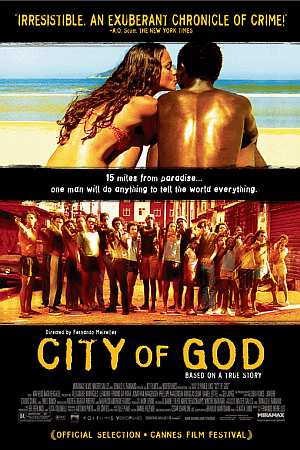
An intoxicating shot of cinematic adrenaline, "City of God" starts with a desperate chicken escaping slaughter and being chased by a gang of pistol-packing prepubescents.

It's an apt allegory for the frantic fight for survival of the protagonists in this ferocious blast of gangster mayhem.

Rocket (Alexandre Rodrigues) narrates our journey into the slums of Rio de Janeiro, the City of God. A child of the 60s, he witnesses two decades of barbarity, greed, rape and revenge which fuel a catastrophic gang war.

Fear and an instinct for self-preservation keep him on the straight and narrow, but his childhood associate Li'l Zé (Leandro Firmino da Hora) grows into the ghetto's godfather - a ruthless, demented killer who makes Joe Pesci's "GoodFellas" psycho look like Mary Poppins.

Comparison's with Scorsese's crime classic are inevitable, given the hyperkinetic action, tar black comedy, and eye-snatching visual panache. But while there's no doubting the genius of "GoodFellas", for all its brutality it remained a caper, a gripping spectacle of hood vs hood, where the mobsters chose their glamour-filled lifestyle and ultimately got what they deserved.

In "City of God", desperation drives children to acts of outrageous violence, crime appears to be the only option in the moral and economic wasteland of the Brazilian favelas. Even the grotesque Li'l Zé is not without humanity, while the fate of other so-called gangsters is poignant.

For all its whiz-bang camerawork and outrageous entertainment value, the movie is grounded by its true life origins (Paulo Lins' fact-based novel), and the superb performances of a largely non-professional cast recruited from the streets. Gut-troubling horror follows cruel bellylaughs, and the relentless action is underscored by unforgiving poverty.

Shocking, frightening, thrilling and funny, "City of God" has the substance to match its lashings of style. Cinema doesn't get more exhilarating than this.


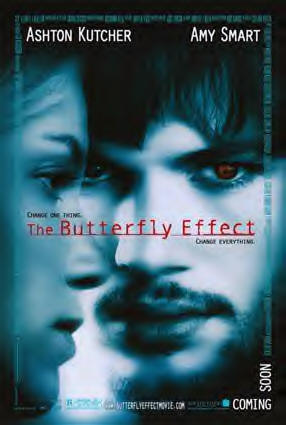
Ashton Kutcher plays Evan Treborn, a troubled man who suffered blackouts as a child. When he discovers a way to travel back into the body of his past self, his time trips start to cause negative results on his present. As he uses his powers to try to fix his past and present, the effect escalates, creating alternate realities, many of which are worse than the past that he is trying to change.

The Butterfly Effect is a terrific thriller that keeps you on the edge of your seat. The previews looked very intense and the whole film is pretty much like that. It held onto the audience right at the start and it didn't let go until the end. The plot is nothing new but the execution was very nice. It offers a bunch of interesting and unpredictable twists so it's hard to see where things are going. The whole film is like that, just one long engaging thrill ride.

The acting is okay, some people did better than others. Ashton Kutcher is surprisingly good as Evan and he does a good job for his first serious movie. Amy Smart is very pretty and talented and she plays Kayleigh perfectly. The only person I didn't really like was Melora Walters. She was pretty wooden and unconvincing. Besides for her, the acting was pretty good and convincing. No one really did a bad job.

This film was directed and written by both Eric Bress and J. Mackye Gruber. They did make their mistakes but the film is still pretty good. The critics never gave this movie a chance. As soon as they heard Ashton Kutcher was in it, they all prepared to give it thumbs down. The movie moves around a lot that its hard to keep up but it also keeps you paying attention. Plenty of movies have gone back in time before but this one does it so more effectively that its almost original in that sense. The beginning is done well, the middle it starts dragging but it starts picking up and the ending is done extremely well. This is one of the best films of 2004 and certainly an entertaining one. In the end, this underrated gem is worth checking out. Rating 8/10

::The Butterfly Effect 2::


Cast: Eric Lively, Erica Durance, Dustin Milligan, Gina Holden, JR Bourne
Director: John R. Leonetti
Screenplay: Michael D. Weiss

The original The Butterfly Effect was the brainchild of writer-directors Eric Bress and J. Mackye Gruber, who had previously written a sequel for another gimmicky series in Final Destination 2. There's more than that connection to link these two different series, as both feature sequels that are only tangentially related to the others, essentially remakes more so than continuations of previous storylines. The problem with a film like The Butterfly Effect 2 is that, unlike the gory, humorous Final Destination series, there really isn't much joy in the plot itself after understanding it the first time. Since we all know where it's going, we have little vested interest in the artificial storyline, and without any humor or titillation to speak of, it's little more than a mechanical, joyless regurgitation, except with no-name stars and lesser production values.

This episode, wholly unrelated to the first film, features Eric Lively (Speak, The Pact) portraying Nick, a 20-something man on the verge of a personal and professional boom. It's his girlfriend Julie's (Durance, "Smallville") birthday, and as special as he wants her day to be, he must unfortunately head back to work, as he is jockeying for a big promotion, and doesn't want the job handed to someone seen as more loyal to the company. Tragedy strikes when he loses control of the car, causing the big rig behind him to smash into his SUV, killing off Julie, his potential promotion, and his happiness. A year passes and he is still not over the event, but he has begun to feel strange effects in the pictures he looks at, finally culminating in regressing himself back into the moments depicted in the photos, this time with the ability to change his future. However, when he returns to the present, Nick doesn't always like what he finds.

Given that I didn't really enjoy the first film, it shouldn't come as a surprise that I also don't have much love for this very redundant sequel. The short summation is that it is essentially the same movie with different characters and situations, and instead of a diary, the time-travel is done through photographs. Even if you did like the first film, I can't really understand what would appeal to you about seeing it done again, as the script by Michael Weiss (Crocodile, Octopus) gives no new twists on the formula, and doesn't ever try to explain how such a bizarre phenomenon could actually happen and why.

Since I can't recommend the film to people that liked The Butterfly Effect, the only audience out there that I could see actually finding this story intriguing would be those that have never seen the original but find the premise interesting. About the kindest thing I can say about this rehash is that it isn't as dark in its tone and themes, making it much easier to take for those squeamish about sadistically repugnant scenes of child abuse. I should point out that, even if I had never seen the original, it is highly doubtful that this would have actually thrilled me as a standalone entry enough to give this a higher rating than I have here.

I suppose there is an irony in knowing that this sequel/remake is the opposite of the main premise of the film. In the fictional story, someone goes back to relive the same events but takes a different direction; in the reality of this sequel, the makers of The Butterfly Effect 2 have chosen to relive different events and choose the same direction. Regardless of the differences, both the fiction and the reality do come up with the same conclusion:- going back and reliving past events doesn't always produce better results in the present.

::Enemy at the Gates ::


Tagline: "Some Men Are Born To Be Heroes."

Length: 131 minutes
MPAA Rating: R for strong graphic war violence and some sexuality.

Early on in Enemy at the Gates, we're shown a map of Europe with Germany colored brown overprinted with a large black swastika and the Soviet Union colored red overprinted with a large white hammer and sickle. Then the brown starts to spread over most of the map as a voice intones, "Autumn, 1942. Europe lies crushed beneath the Nazi jackboot. The German Third Reich is at the height of its power. Hitler's armies are charging through the heart of the Soviet Union towards the oil fields of Asia. One last obstacle remains: the city on the Volga where the fate of the world is being decided -- Stalingrad." From this point on, we're in for an old-fashioned World War II story with exciting action sequences, a heavy-handed musical score, and a legendary hero.

We're soon shown a harrowing combat sequence where the desperate Soviets throw everything they have into the defense of Stalingrad. But the Soviets don't even have enough rifles to issue one to each soldier, so they issue as many as they can and send all the soldiers into combat with the instructions: "The one with the rifle shoots. The one without, follows him. When the one with the rifle gets killed, the one who is following picks up the rifle and shoots." The Soviet troops are slaughtered when they charge the Germans, but when some of them try to retreat, they're shot by their own officers.

In the chaos of battle, two Soviet soldiers wind up in a large, ornate fountain in the city center. One of these is Sergeant Vassili Zaitsev (Jude Law), a former shepherd who is extraordinarily proficient with a rifle since he grew up in the Urals shooting wolves. The other is an idealistic political officer named Danilov (Joseph Fiennes), a gifted public relations man whose combat skills are minimal. Danilov watches as Vassili kills five Germans, and the two Russians are able to get back to the Soviet lines safely.

Meanwhile, ruthless Soviet dictator Joseph Stalin is determined to hold Stalingrad at all costs, partly because of its strategic importance, but also for psychological reasons: The city has been named after him. Stalin's envoy Nikita Khrushchev (Bob Hoskins) comes to Stalingrad and warns a group of Soviet political officers, "If the Germans capture this city, the entire country will collapse." Khrushchev demands suggestions as to how to motivate Soviet troops to stand up to the Germans, and Danilov proposes, "What we need are heroes." "Do you know any heroes around here?" asks Khrushchev, to which Danilov replies, "Yes, Comrade, I know one."

With Khrushchev's support, Danilov uses newspapers and radio to make Vassili a national hero. Vassili is transferred to a sniper unit, where he rattles German nerves by gradually picking off dozens of their officers in Stalingrad. Soon Vassili has to answer boxes of fan mail, but his writing skills are so limited that his responses are dictated by the wordsmith Danilov.

One day Vassili and Danilov meet the attractive Sergeant Tania Chernova (Rachel Weisz), and we eventually learn that women served in combat positions in the Red Army during World War II. Both Vassili and Danilov fall in love with Tania, but Tania loves only Vassili. Later in the film there's a tender scene where Tania and Vassili lie in a room filled with Soviet soldiers sleeping fitfully because they all know that most of them will be killed the next day. Tania removes her glove and pushes her bare hand down inside the front of Vassili's trousers, and moments later they make love with the lower parts of their bodies covered by a blanket.

Meanwhile, the German high command has become painfully aware of Vassili and sends their top sharpshooter, Major Konig (Ed Harris), to kill him. Konig is an aristocratic Bavarian whose son died at the hands of the Russians at Stalingrad. When Konig arrives to carry out his mission, German General Paulus asks him, "How are you going to go about finding this young Russian?" "I'll fix it," answers Konig, "so that he is the one who finds me." This sets up the most involving part of the film as Vassili and Konig enter into a deadly cat-and-mouse game in bombed-out stores and factories.

Through Tania, Vassili befriends her neighbor, a young boy named Sacha (Gabriel Marshall-Thomson). Sacha quickly comes to idolize Vassili. But Sacha also works as a shoeshine boy, and one day he shines the boots of Major Konig. Thus, Sacha becomes the only direct link between Vassili and Konig, and Konig plies the boy with chocolate in the hope of getting information about his adversary. One day Konig asks Sacha about Vassili, "Is there a girl he loves in his village?" "Not in his village," answers Sacha. "Here!" "Does she love him?" Konig asks, and Sacha responds, "Yes, because he's handsome! Because he's brave! And she's very beautiful. I know her well. She's from my neighborhood... Later, the two of them will get married." But Sacha has put himself in grave danger because Konig now realizes that the boy's admiration for Vassili is so great that he won't betray him.

Quite a few twists and turns remain, but the movie goes on to show the tragic fate of young Sacha. We also see an unexpected act of heroism by Danilov and learn how the sniper duel between Vassili and Major Konig comes out. In a brief epilogue, we see the Soviets celebrating victory, and we find out a little more about what happened to Vassili and Tania. This is an old-fashioned picture where all the loose ends are neatly tidied up.

Enemy at the Gates is a heavy-handed movie, and anyone expecting subtlety will be disappointed. But I see this film as spectacle, and viewed that way, it works well. The huge battle scenes are absolutely terrific, and the sniper scenes in a department store and a chemical factory are gripping. Also, when larger-than-life characters get to make speeches -- like when Bob Hoskins as Nikita Khrushchev says, "Vodka is a luxury we have. Caviar is a luxury we have. Time is not." -- it's great stuff.

It's too bad, though, that Enemy at the Gates isn't really successful at balancing its grandiose scenes with intimate moments when we get to know two or three of the individual characters better. It seems to me that all the raw materials were present in this movie for me to be exhilarated at some moments and deeply saddened at others, but this didn't happen because the human dimension to the story is largely missing. In particular, even though Jude Law is a good actor, his character Vassili Zaitsev is written in such a way that he doesn't evoke much of an emotional response. I can't help comparing Law's Vassili with Gary Cooper's portrayal of the title character in Sergeant York, and it seems to me that Cooper's York comes off as the more heroic figure by far.

It may be a little impolite of me, but perhaps I should say something about the language conventions used in Enemy at the Gates. Since the film is aimed at English-speaking audiences, it's not surprising that all the Russians always speak in English. However, the Russians print and write in Russian, so if it's important for English-speakers to know what's printed or written, English subtitles are used. This treatment of the Russian characters isn't too strange, but it seems very peculiar to me that the Germans speak in German, unless it's important for English-speakers to know what they're saying, in which case they speak in English! It's possible that the conventions chosen were the best way of dealing with the language problems posed by this movie, but I sometimes found this a little jarring.

I would say that Enemy at the Gates is a good, but not a great, movie. During the film's combat scenes and the duel between Vassili and Konig, it's very good indeed. But when it tries to show the conflicted friendship between Vassili and Danilov or the romantic relationship between Vassily and Tania, the movie falters. Still, I recommend Enemy at the Gates as a good chance to learn a little about history and be entertained at the same time.

;;